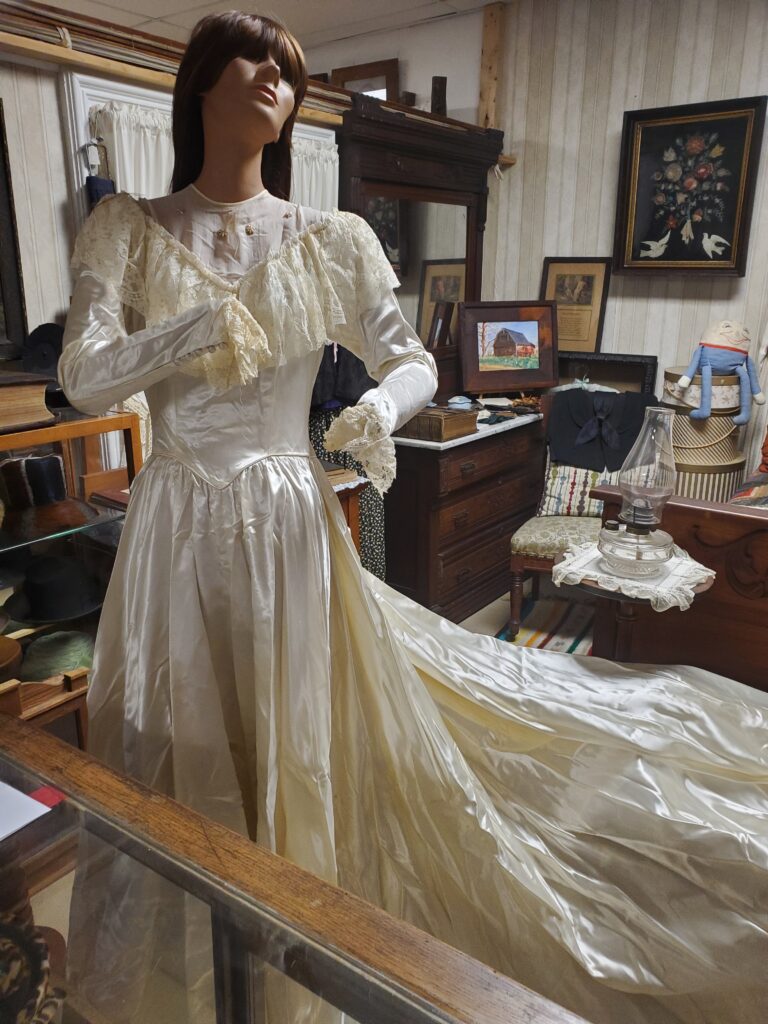
It’s just a wedding dress, staged in a thoughtfully arranged exhibit in a small-town museum.
Well, no, it’s not just a wedding dress. It’s the ivory satin, delicate lace, long-trained beauty first worn in 1940s Kewanee when Madeline Stuhlsatz married Chet Rodak. And then given to me for my 1950s Neponset wedding to Wayne Gerrond. What a generous gift.
And the small-town museum? It’s a little gem on Commercial Street in Neponset, lovingly maintained by the Neponset Historical Society. In 1982, new mayor Chuck Blake suggested to the village board that such a society was a good idea. Ruth Gould, locally admired and retired elementary teacher, was inveigled into taking the lead in the project. She put her heart into it.
The fledgling museum first took up quarters in a couple of rooms in the old town hall. Soon it was gifted with Mock house, the oldest dwelling in town. Desperate for more room for the growing collection, the Society later sold Mock House and acquired its present home, the Commercial Street building where Dr. William Bertelsen developed the Aeromobile, first hovercraft to carry humans over land and water. A prestigious setting for a tiny town, wouldn’t you say? Home of a history- making invention?
Of course, the building needed repair and restructuring; it still calls for considerable maintenance. And who does all this work? Almost always volunteers. How is it funded? Almost entirely directly out of the pockets of the local population. The village government helps out in any way it legally can; the Society sponsors activities such as the Picnic Day pie auction (only ten pies entered, well over a thousand dollars garnered—not bad, eh?); and donations from individuals and Neponset organizations.
Today the museum operates under President Mark Bowen, Secretary Pat Weeks, Treasurer Gale Pickering, Curator Adam Kelly, and Directors Ed Safiran, Tom Weeks, Lorene Decatur, and Julie Witte. This isn’t a board that meets once a month, runs through a dry agenda, then scats out for the nearest place of refreshment. No, if you’re on the board you are expected to literally “get your hands dirty” with the project of the moment. I’m amazed at how many artifacts are on display, thanks in large part to the artistic skill of Curator Adam Kelly. Yet nothing seems crowded or in the wrong surroundings.
Future plans include a possible expansion onto the next lot, donated by Amy Wren and Jill Dzekunskus in honor of their grandmother, the late Verna Cinnamon. (Verna was well-known in this area for her long-time hands-on support for the Historical Society.)
There is so much more to be told about this little museum, this reflection of once-upon-a—-time-around-Neponset. As with churches and libraries, museums connect us with those who came before us, survived and even triumphed through times just as good and bad as they are today. “Connectivity”–(not sure Webster recognizes this word) we could use more of that today.
Maybe the real story is what’s so right about the United States. In 1982 some Neponset citizens decided we needed a historical museum. They worked hard and peacefully to get one. Because it was self-funded, no government at any level dictated the contents, or issued strangling regulations. Across this country there are still millions of institutions large or small who operate this way. Let’s keep them going.
Your friend,
Carol