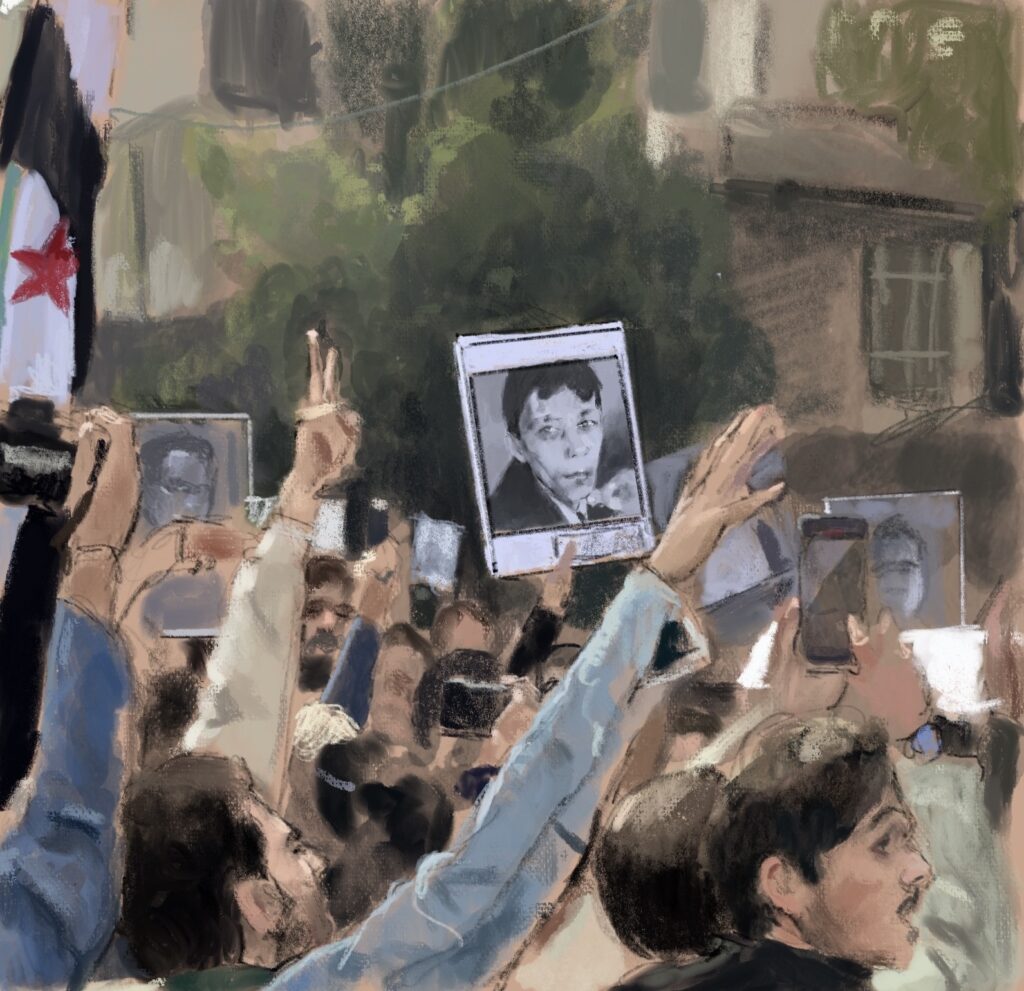
Marc Nelson, Kewanee artist and teacher, was featured in a CNN news report that aired last week titled, “The dead, the missing and the reunited: Three tales of Syria’s tortured prisoners.”
In the report, Nelson was interviewed about his friend Mazen al-Hamada, who was disappeared into a Syrian prison.
Nelson met Mazen, a prominent figure in the human rights world, after watching a 2017 film, “Syria’s Disappeared: The Case Against Assad,” by his filmmaker friend Sara Afshar. It was in that film, Nelson said, that “Mazen’s testimony reached an international audience.” After watching Sara’s documentary, Nelson reached out to Mazen and the two became fast friends.
As an artist, Nelson did what he knew he could, he picked up a sketchbook and pencil and began documenting Mazen’s testimony through his drawings and sketches.
“After Mazen was disappeared in 2020, I was afraid that the Assad regime would erase Mazen’s social media presence, so I quickly took screenshots of Mazen’s photos and posts,” he said.
Almost every week after Mazen’s disappearance, Nelson posted drawings of his friend on social media, listing the number of days he’d been missing, trying to keep him in the world’s attention.
“These sketches were widely shared as well as interviews about Mazen, books including my drawings, and an exhibition last fall documenting his disappearance,” he said.
How Mazen became a prominent human rights figure goes back to 2011 during an uprising in Syria that erupted against Assad’s regime. Mazen was on the front lines and one of the first to join in the demonstrations against Assad. That, according to the CNN report, made him a target, and in 2012, Mazen was detained by security forces and for nearly two years was subjected to medieval torture tactics.
After this release from Assad’s torture prison in 2013, he fled to Europe.
“He became the most vocal advocate and witness for the thousands of Syrian civilians still detained by the regime,” Nelson said. “Mazen traveled the world, speaking courageously about his horrific torture, hoping that the international community would take action.”
It didn’t, and Mazen was traumatized by his experiences and depressed by the lack of global response to this horrendous crisis, Nelson said.
“He became synonymous with the plight of the detained and was a prominent figure in human rights/genocide studies circles,” Nelson said.
In 2020 Syrian government officials in Europe where Mazen was living, coerced Mazen to return to Syria, according to Nelson. They threatened his family and promised to release prisoners. Despondent, Mazen, who had his refugee/asylum status revoked by the Netherlands, was desperate to save his family and help the detainees, returned to Syria, in spite of the pleadings from his friends.
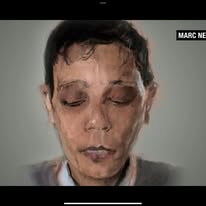
“He was immediately disappeared,” Nelson said. “For four years his fate was unknown. Then, on Dec 9, 2024, when the extermination prison Saydnaya (near Damascus) was liberated, rescuers found Mazen’s body. He had been alive the whole time. He was murdered about a week before the fall of the Assad regime,” said Nelson.
Nelson was devastated to learn that his friend had been murdered so close to his beloved country’s liberation.
“I am glad that his story, his heroic legacy is being shared so widely,” said Nelson. “I just wish it happened during his lifetime. Now that the unspeakable horrors of Assad’s prisons are being revealed to the wider world, I hope humanity will finally listen to the urgent voices of people like Mazen.”
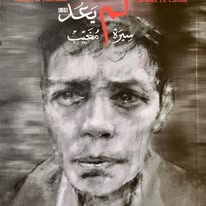
Nelson has tried to sound the alarm for his friend and for the Syrian people through his daily sketches posted to his social media pages. He will continue to do so, he said.
“Mazen’s story didn’t end with his murder. He has passed the torch to us, and it is our duty to seek justice for Mazen and the hundreds of thousands of precious lives stolen by the genocidal Assad regime and his allies, Putin and Iran’s Khamenei,” he said.
Nelson said his friend’s fate was murder, his broken body was covered with signs of torture.
“His memory and legacy will be a guiding light for a more democratic safe and peaceful Syria. He is a hero, and his funeral, attended by thousands, was a hero’s funeral,” Nelson said.
As for the Syrian people and their future now that Assad has been ousted, Nelson hopes that Syria becomes a democratic country for all Syrians, regardless of sect, religion or gender.
“My hopes echo the wishes of the majority of the Syrian people. Ultimately, it is their country, and Syrians alone should decide what is best for Syria,” said Nelson.