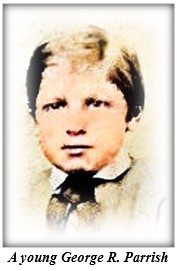
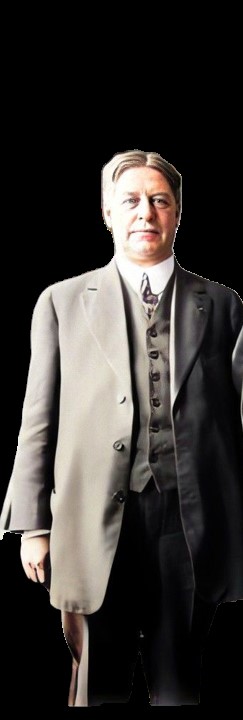
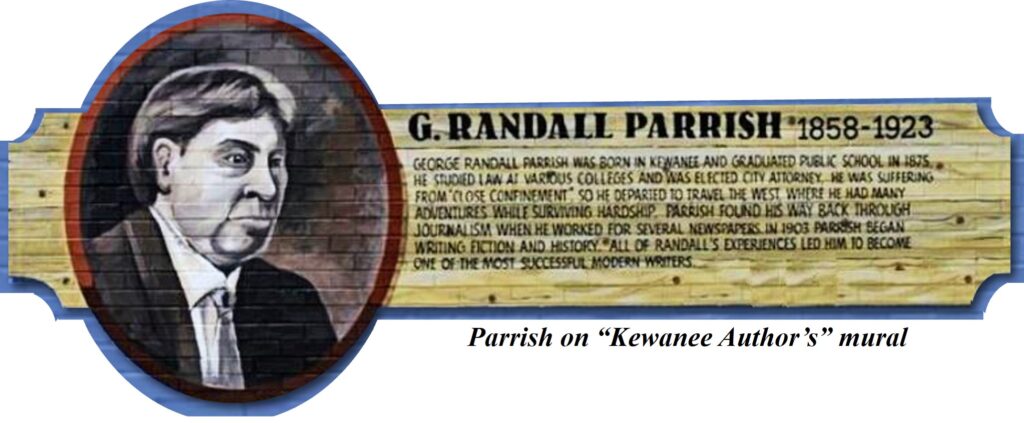
G. Randall Parrish is one of four famous Kewanee authors depicted on a Walldogs’ mural now residing on the north side of the Kewanee Public Library. The Kewanee Historical Society wrote this about Parrish when describing him on the mural:
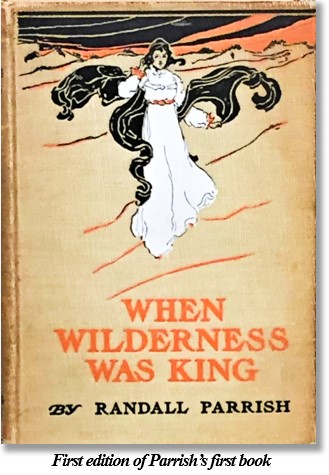
“Born in Kewanee in 1858 the son of Kewanee pioneers Rufus P. and Frances A. Hollis Parrish, he graduated from the old Academy (Kewanee High School) in 1875. Four years and four schools later Parrish became a lawyer in Iowa. Before returning home, he experienced a variety of occupations, including law, itinerant railroading, sheepherding, gold mining, journalism and the ministry in several western states and Illinois. His first novel, “WHEN WILDERNESS WAS KING,” was published in 1904 while he was working as a reporter in Chicago. Encouraged by his initial success, Randall Parrish (the name he used for his novels) came home accompanied by his second wife, Rose Tyrrell, to devote full-time to writing his stories.”
Those accounts, however, are missing a “small” detail of Parrish’s life:
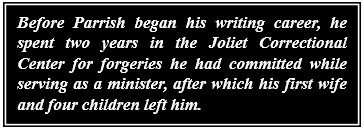
Before Parrish began his writing career, he spent two years in the Joliet Correctional Center for forgeries he had committed while serving as a minister, after which his first wife and four children left him.
A fairly important detail in the arc of a life.
Let’s explore that unmentioned detail of Parrish’s life a little more fully.
In 1886 after Parrish had been editor of a Grafton, Nebraska newspaper, he entered the Congregational ministry and eventually took charge of churches at Leigh and Howells, Nebraska.
In 1887, Rev. Parrish then married Mary A. “Minnie” Hammon of Clarkson, Nebraska. The couple eventually had four children as they moved around the Midwest following his calling. He had pastorships in Harvard, Nebraska; Mattoon, Illinois; Constantine, Michigan; and Marshalltown, Iowa. The latter stop was where he was preaching when his treachery was discovered in 1898.
The specific crime for which Parrish was charged began on July 17, 1895, when the bank of Sandwich, Illinois, received a letter from a Toledo, Ohio, bank enclosing a check for $300 from the Illinois Home Missionary Society payable to a Rev. Mark Thompson. A man calling himself Rev. Thompson then appeared in Sandwich and the check was paid.
But both the check and letter proved to be forgeries, the American Bankers Association took charge, and the Pinkerton Detective Agency began investigating.
The scenario occurred again, this time with a Watertown, Wisconsin, bank receiving the letter and check. But the scheme failed because the local pastor was out-of-town and could not confirm the contents of the letter.
Yet a third attempt at an Elkhorn, Wisconsin, bank failed when the reverend named on the check, this time a Rev. Edward Aiken, failed to appear.
At the same time, it was discovered that letters purportedly from the American Board of Missions, sent to various boards of Congregational churches in need of pastors and asking them to give a Rev. Parrish a trial as pastor, were also forgeries.
The detectives subsequently came to believe that Parrish, Thompson, and Aiken were the same person. In all cases, the handwriting on the letters was similar, the bank letterheads were forged, and the various banks and the church societies identified in the letters and checks disavowed any knowledge of Parrish, Thompson and Aiken.
The detectives then examined the names of regional Congregational ministers. They discovered that there was a real Rev. Parrish serving as a minister in Marshalltown.
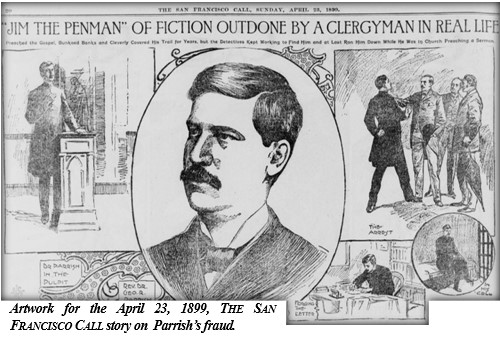
Continuing their investigation in Marshalltown, the detectives discovered that Rev. Parrish had received his call under what proved to be another forged letter of recommendation.
At the conclusion of a late October Sunday morning service, the detectives showed Parrish a warrant for his arrest for forgery, he was taken into custody, and he was taken to Sandwich for trial.
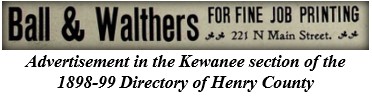
Represented by well-known Kewanee attorney Charles K. Ladd, Parrish initially denied all charges. But then parishioners in his former church in Constantine, Michigan, discovered a box belonging to Parrish. It contained letterheads, envelopes and checks of non-existent entities, all printed in Kewanee by Ball & Walthers printers.
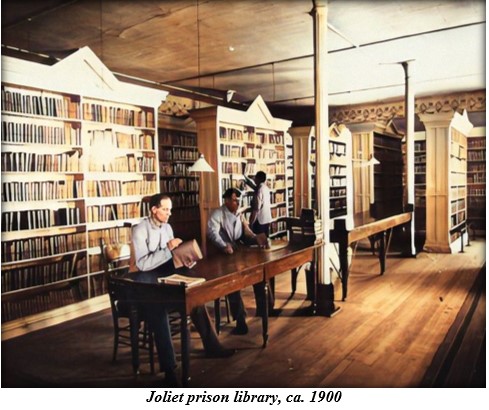
In November before his trial commenced, Parrish pled guilty to forgery and was given a sentence not to exceed 14 years, to be served at the state penitentiary in Joliet. (During his time in prison, he, naturally, worked in the prison library.)
Devastated by her husband’s duplicity, Minnie left with her children and went to live with her parents. She then filed for and received a divorce. In 1900, she told a reporter that
“[w]hen the charges against Mr. Parrish were all sifted down there were found to be twenty-seven in all, dating back seventeen years. I would not have left him, not thought of such a thing, if he had been at all penitent, and if I could have hoped for any change in him for the better.”
When Parrish was released from prison after serving two years, he first moved to Chicago where he returned to being a reporter. But in his spare time, he began writing the first of his novels. He then left Chicago to return to Kewanee, where he met his second wife, Rose Tyrrell, when both were working in the Boss Company factory. They married in 1902 and moved into his parents’ home at 235 S. Chestnut St., where he lived for the rest of his life.
The rest of Parrish’s story is well-known. He produced at least one book each year through 1922, except for 1921. He published two books a year in 1904, 1905, 1907, 1912, 1913, 1916, 1918 and 1922. His books were mainly romantic novels, sometimes call “dime novels,” set against historical backgrounds.
Parrish traveled the lecture circuit when not writing, and during World War I spoke on behalf of Liberty Loans and the Red
Cross. Between 1911 and 1922, he wrote for Chicago-area newspapers, and some of his stories appeared as serials in newspapers before they were published in book form.
In 1911, Parrish was awarded an honorary Doctor of Literature from the University of Iowa.
Parrish died of heart problems on August 9, 1923, in Kewanee.
George Randall Parrish, born near Kewanee’s beginning, led an adventurous life. He also, for a time, led a life of crime. But he found his true calling and returned to his roots. He served time for his failings and was honored with a mural for his successes.