Crystal Lake Park flowed from the city’s quest for water
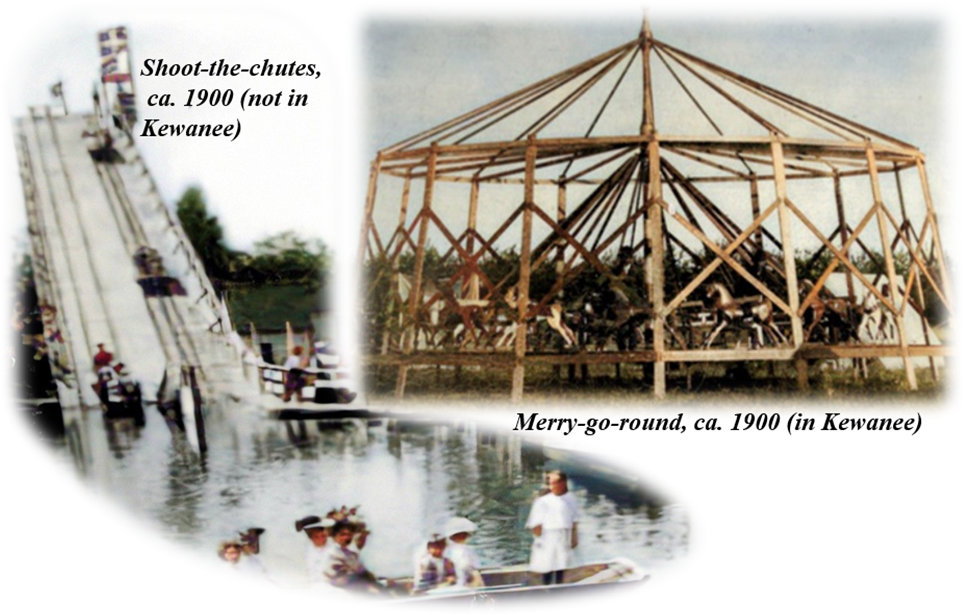
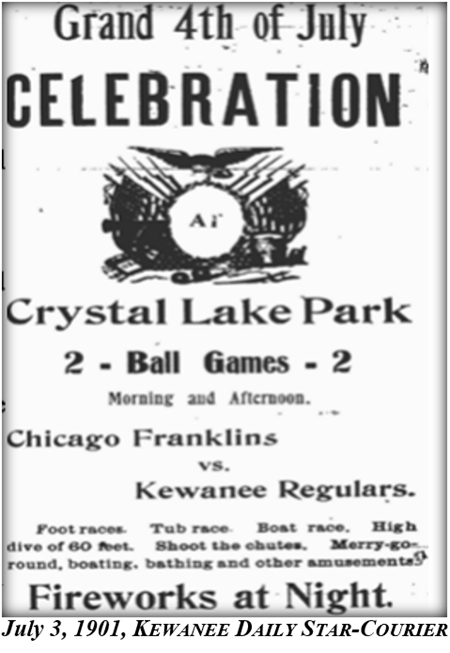
Kewanee’s first amusement park, Crystal Lake Park, opened in the summer of 1900. It offered swimming, boating, a high dive, a two-track water chute, a merry-go-round, a refreshment stand, and a pavilion with music. There were picnic grounds and a baseball field, and in winter, there was ice skating, and the chutes could be converted for toboggan use. And then, only a few years later, Crystal Lake remained but the park was gone.
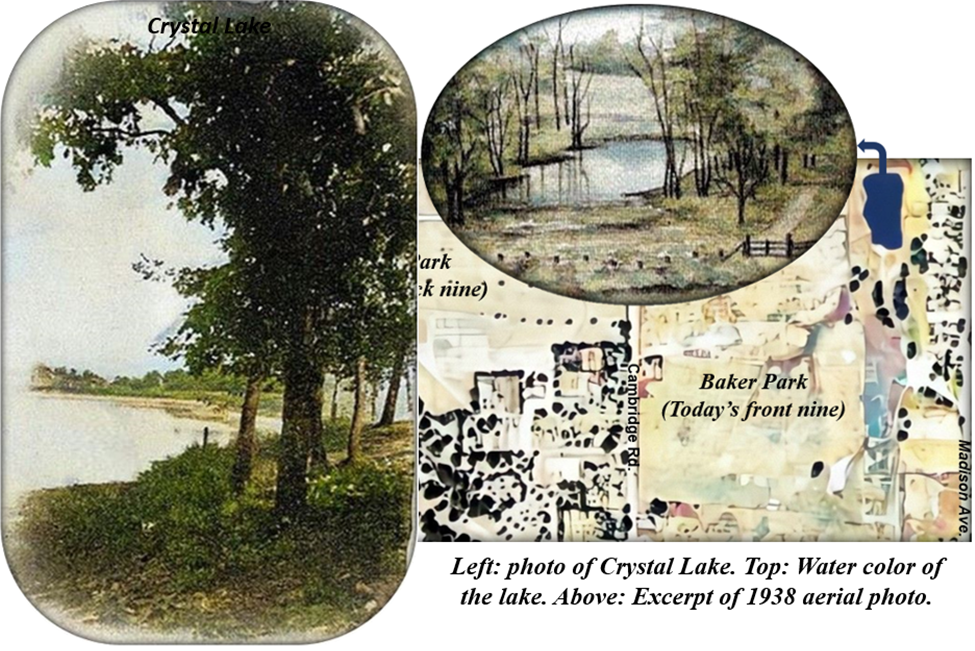
How did Kewanee’s first amusement park come about, and what happened to it?
The park was an unintended by-product of the village’s nearly 25-year pursuit of a reliable water supply.
When Kewanee was founded in 1854, the first source of water was Bronsen’s well, to the northwest of Baker Park, and rain barrels catching rainwater. Then, villagers began sinking private wells.
Later, public wells were sunk, primarily to provide a water source to fight fires. As streets that turned to mud when it rained were pulverized into dust when dry, water from those public wells was also needed to sprinkle the streets to keep the dirt down.
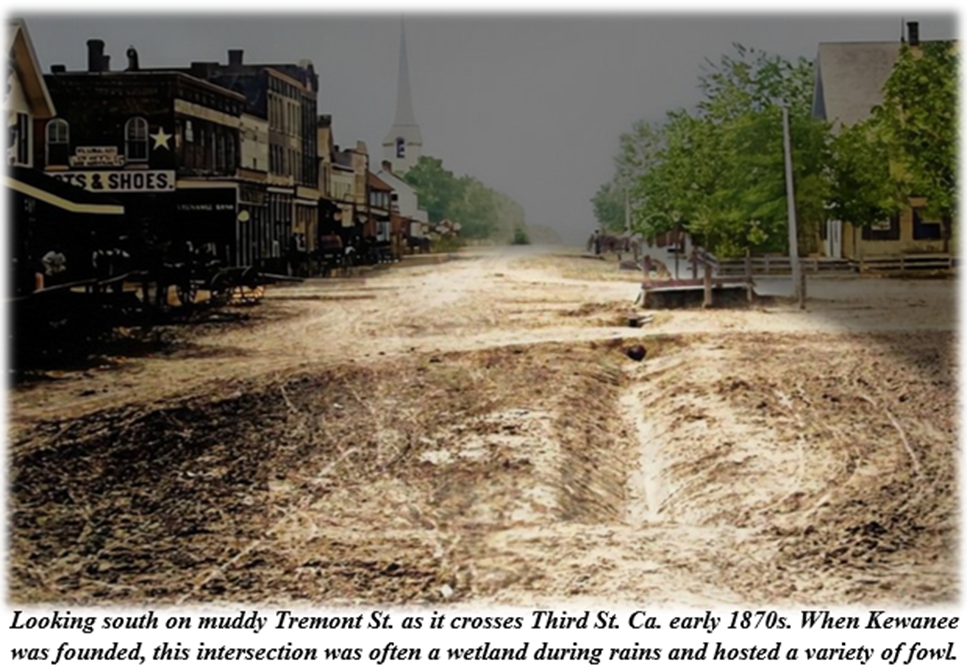
By the mid-1870s, there was a good deal of talk about the need for a steady village-wide water supply. After the Chicago, Burlington, and Quincy Railroad put in the lake on Charles K. Ladd’s property in 1879 (which Ladd then used to create East Lake Park), it was thought that the lake could serve as the water source Kewanee needed. But the C. B. & Q. eventually decided not to share the lake with Kewanee. The Haxtun Steam Heating Company similarly decided not to share its source of water with the village. Kewanee trustees realized that the growth of business in Kewanee was impeded by the lack of a water source, but the village continued to obfuscate.
That is, until a Saturday night in January 1887, when a fire at the C. B. & Q. depot finally convinced Kewaneeans to build a water plant. Ironically, it was C. B. & Q. water works employees who discovered the fire in the baggage room, but as the fire spread to the depot, there was too little water available to stop it, and they could only manage to save the freight house.
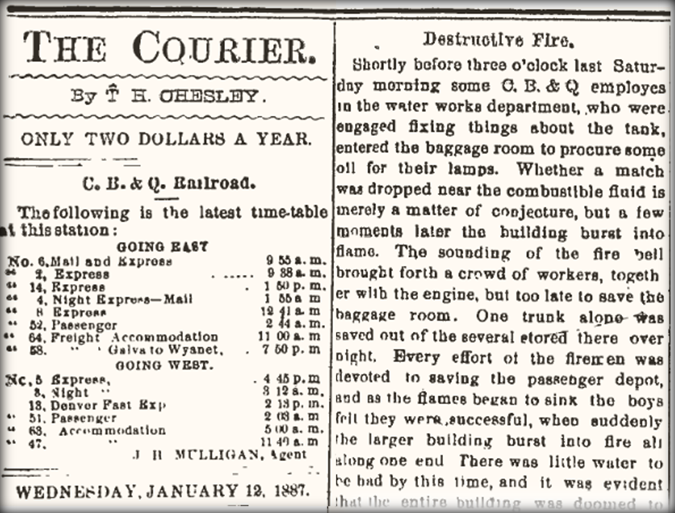
As reported in the Independent newspaper on January 13, 1887, “[t]he burning of the station house . . . has aroused our people to the importance of providing a water works. Had there been an abundant supply, we have no doubt the depot could have been saved . . .” Soon a petition circulated, and the village began a search for a permanent water source.
After tests, the village finally settled on an underground stream north of town. Contracts were let and work began on the water works, a dam, a reservoir, and laying pipes to the village. (In addition to hired crews of workers, “the big gang of tramps who had been arrested . . . were taken out of jail and put to work digging ditches for the water pipe north of town.” The newspaper was surprised by the result – “[a]ll but two or three worked hard and faithfully, and some of the bosses say they accomplished more than the same number of regular hands.”)
Soon, the work was completed, and assessments were made. The paper reported that “Kewanee was as well protected in case of fire as any town of its size in this vicinity.”
There were hiccups along the way. For instance, the original reservoir dam failed to hold water and was eventually replaced by what was sometimes referred to as the water works, a 295 ft. long, 75 ft. wide and 16 ft. deep lake. But the water works was successful. As an added bonus, the village generated an income stream from letting out use of the lake and adjacent land. It became a source of block ice in the winter, and ice skaters enjoyed spins around the lake.
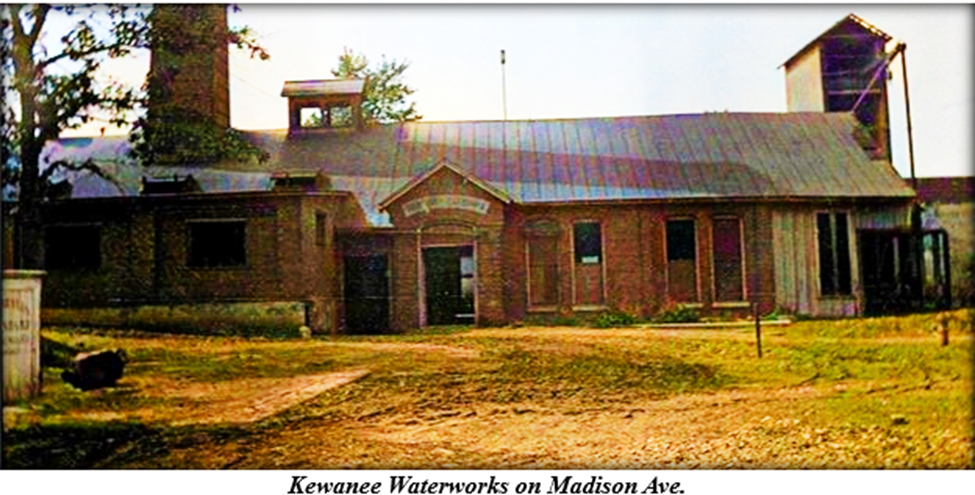
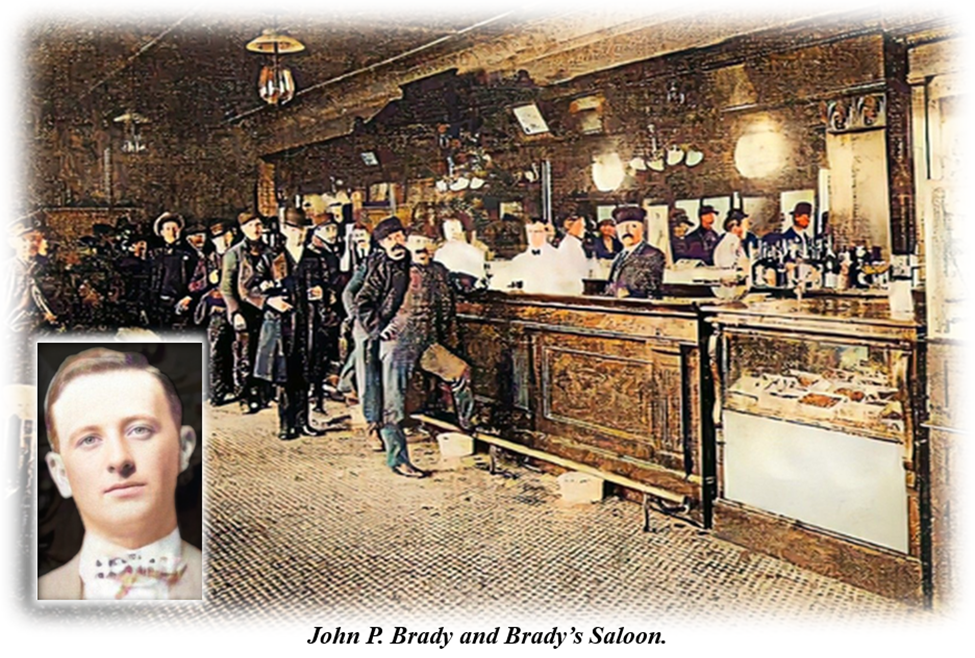
Now back to the amusement park. In 1900, the village granted the firm of Brady & Olson use of the water works lake and grounds for an amusement park, for a period of five years. John P. Brady, owner of Brady’s Saloon (today’s Cerno’s) was an all-round raconteur with his fingers in many enterprises. By late summer, the newly named Crystal Lake Park was opened.
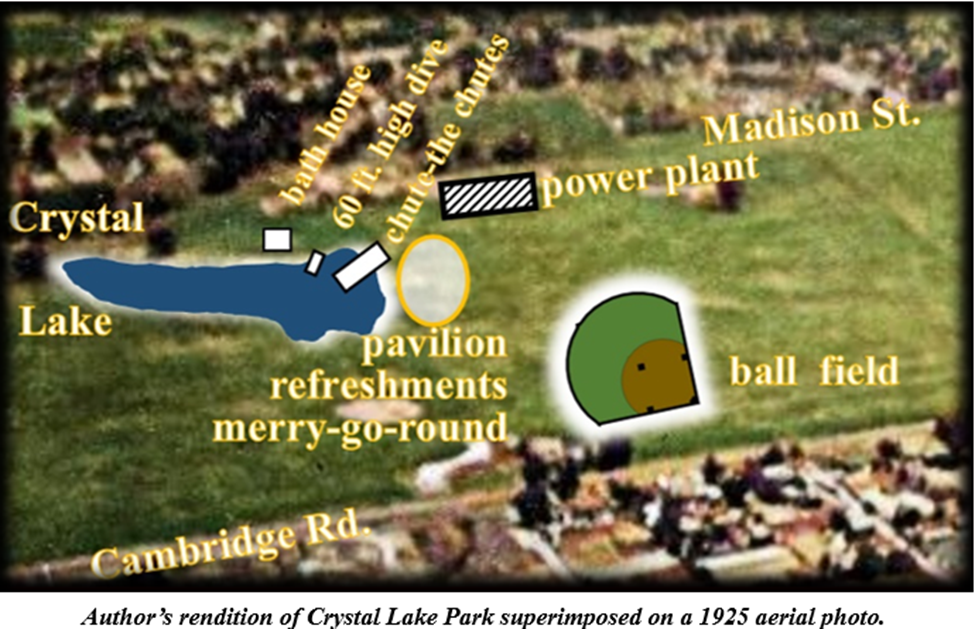
The water chutes were the center of attraction, with two boats “shooting-the-chutes” into Crystal Lake. There was a dock for row boats north of the chutes, a 60-foot-high dive, and a bathing house north of that. South of the lake, a refreshment stand, merry-go-round, and other means for patrons to spend money were built.
Bands played on the nearby pavilion, picnics were regularly held on the grounds, and soon a ball field was laid out to the west of the power plant. In winter, the chutes could be converted for toboggan use and there was ice skating on the lake. The only complaint was the lack of sprinkling to keep down the dust on the access road to the park. The park was an apparent success.
Something changed in 1903 and 1904. The financial interests behind the street cars re-named Ladd’s former East Lake Park, a mile east of downtown, to Terminal Park, put in a new pavilion and other attractions, built a ball field, and then built a rail line to it. The “new” park drew throngs.
The Crystal Lake amusement park closed in due course, and even the ball field fence was moved to the new Terminal Park field, ending baseball at the field behind the water plant.
But Kewanee had a taste of all that a park could offer, and soon other parks began to spring up.
(For more on Kewanee’s parks, my book, A Brief History Of The First Years Of Kewanee Parks, is for sale at the Kewanee Historical Society and on Amazon and is available for check out at the Kewanee Public Library. You can also view my video on the parks, based on my presentation at Windmont Park in 2023.)