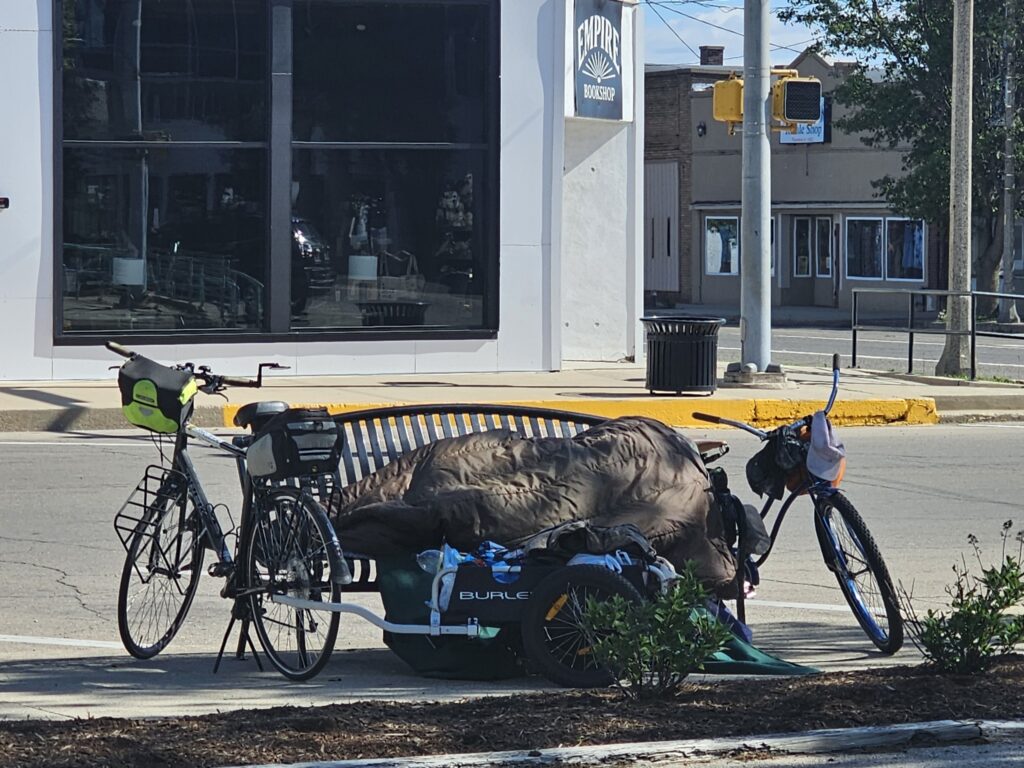
Three possible ordinances intended to revise the city’s health, safety and sanitation ordinance were presented to the Kewanee City Council Monday by the chief of police.
Chief Stephen Kijanowski addressed growing concerns about the obstruction of public spaces, in particular people sleeping on city benches and in parks, and presented the council with three ordinances that would help to resolve this issue, while still protecting people’s rights.
Kijanowski said the first option focuses on helping with sanitation use of the public space; the second option would focus on the regulation aspect while the last option would focus on banning the obstruction of public spaces.
While Kijanowski told the council that the ordinance change wouldn’t be implemented to target unhoused people, the changes do come out of growing concerns about people sleeping on benches, sidewalks and other public spaces.
Kijanowski said the only option law enforcement currently have in addressing that problem is to write a littering ticket. The ordinances, he said, are the most compassionate alternative to a ticket and keep penalties out of the equation
Kijanowski emphasized the amount of research gone into this ordinance, and wanted to address community concerns while still respecting people’s rights.
“We are not after penalties or money, we just want to provide public access,” said the chief.
Kijanowski said that when law enforcement confronts people camping in public spaces, they offer them as much help as they can by giving them resources for things like public housing and help through Project Now. Most take them up on the help, and others flat out say no, he said.
Since police officers often have a wide range of reactions from people who are asked to leave a certain space, Mayor Gary Moore said the goal is to show compassion as long as possible; until it is no longer a viable option.
This ordinance would apply to any person or business that is obstructing public spaces, and will be implemented fairly and equally, Kijanowski told the council.
An example of this would be a business doing construction and keeping supplies laid out on the sidewalk for the entire project. Temporary obstruction is fine as long as it is approved by the city, he said.
Law enforcement would implement this ordinance by giving the violator a 24-hour notice to clear out the public space, or in the case of a person camping, law enforcement must first offer them help.
The ordinance was a discussion-only item and the council did not vote on the matter.