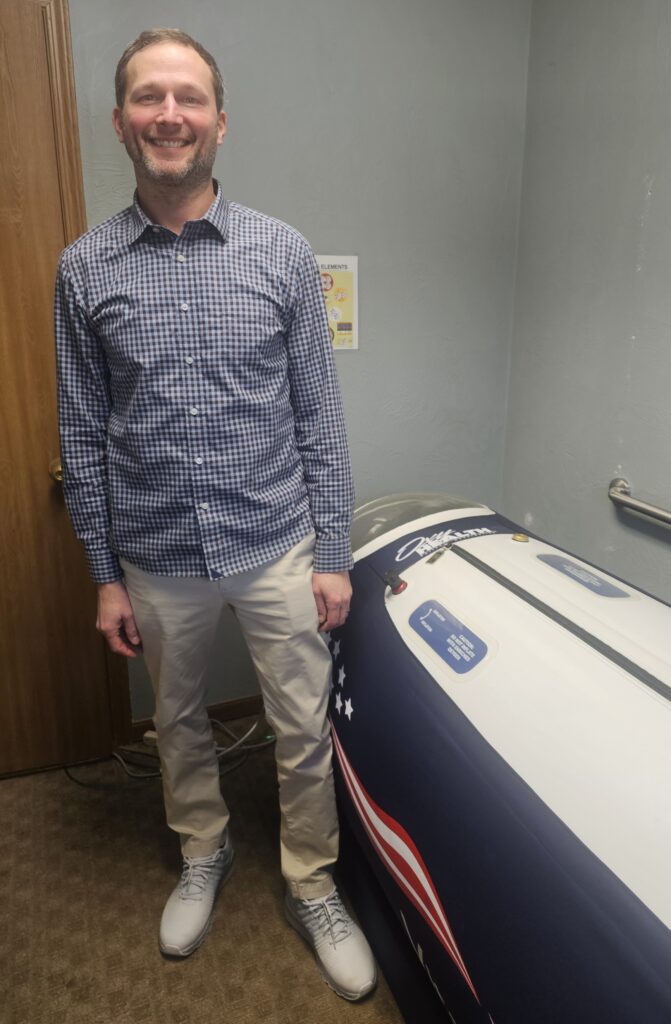
Dr. Chad VanDeVelde has always been passionate about his work at VanDeVelde Wellness Center. Since 2007, the Kewanee chiropractor has been combining his chiropractic care with a holistic approach to wellness and a focus on getting optimal results for his patients, all while maintaining the small town doctor vibe.
“So I’ve been in practice for 15 years and always had an interest in different therapies that could help people in my community,” he said.
His approach has combined different therapies such as nutrition, phytotherapy, acupuncture, and laser, and he has completed hundreds of hours of post-graduate training to become certified in those fields.
But in 2021, a family member was diagnosed with dementia, and a therapy that has always intrigued him took front and center.
“I knew exactly what to do,” he said.
That’s because a decade ago, VanDeVelde began researching Hyperbaric Oxygen Therapy (HBOT) that involves a patient breathing pure oxygen in a pressurized environment or chamber. He had hoped to purchase one of those chambers for his practice. But at the time, he and his wife, Christina, were raising four small children and spending time with his family was his utmost priority, he said.
But the thought of helping a family member with the oxygen therapy only solidified his determination to purchase a chamber for a therapy that wasn’t new to him nor the medical field.
“The therapy has been around for over 300 years,” he said.
The FDA-approved uses for HBOT are wound healing, thermal burns and air embolisms to name just a few. But the FDA also notes on its website that “some claims of what it can do are unproven.”
VanDeVelde said that the off-label indications for HBOT are numerous and he has delved into the public studies that show the therapy can be effectively used for multiple conditions. The thinking has changed, and one of those off-label indications is neurological conditions and so, with a family member in need, VanDeVelde purchased a chamber.
“Most people have heard of this therapy for wound healing,” VanDeVelde said. “The same science and physiology needed to heal a wound on the skin is the exact same science and physiology needed to heal a wound in your brain; a wound in your colon; a wound in your nerves. The only difference is we’re able to see a wound on the surface, but we need special imaging to see the internal wounds.”
For a year, he utilized the chamber for family only, but when his family member’s symptoms and quality of life improved, he flew to New Jersey for an HBOT course, and in 2022, he became a certified Functional Medicine Hyperbaric Practitioner.
“I have been blessed to be in a position where I could help a family member,” he said, but VanDeVelde wanted to do more. He wanted to help his community.
Since April of 2022, he has been offering the therapy to the community and VanDeVelde can point to success stories. While the therapy doesn’t cure or treat diseases, and he’s very clear about that, it has been shown to improve symptoms associated with diseases and conditions, thereby improving the quality of his patients’ lives.
His patients helped by HBOT include a post-stroke patient who needed a walker, wasn’t able to drive and had difficulty with speech and communication.
“We did 40 hours and completed tissue change,” he said. “That patient showed incredible improvements.”
An MS patient that couldn’t walk 30 yards is now walking two miles a day, he said. A patient with post-concussion migraines is now migraine free.
Another patient with long-haul Covid couldn’t go down steps and is now walking a mile a day. VanDeVelde administered the therapy to a teen with Pott’s disease, a rare form of tuberculous that affects the spine. The patient had seen multiple neurologists and specialists before one of those doctors recommended HBOT. The once homebound teen is now back in school.
VanDeVelde admits that there are some chronic conditions that require long-term ongoing maintenance care and hour-long sessions can number anywhere from 10 to 40 for the full benefit depending on the severity and length of time the patient has had the condition.
The body relies on oxygen, VanDeVelde explained, and the only way to heal damaged tissue is through red blood cells carried through the circulatory system.
“We can go days without water, weeks without food, but only minutes without oxygen,” he said.
If there is damage to the circulatory system, oxygen can’t get to the tissue. The therapy reduces volume and increases pressure, carrying oxygen to damaged tissue.
HBOT, he said, can reach tissues that no other therapies can reach. One of his patients had an abscess in his intestines and was waiting on surgery to remove two feet of his colon. While waiting for insurance approval, the patient began receiving HBOT and improved.
“He did not have to have the surgery,” he said.
But the magic happens not inside the chamber, but once a patient steps out, he said.
While in the recovery phase of the therapy, the patient is getting more oxygen than ever before. That oxygen provides energy and has anti-inflammatory effects.
“Oxygen triggers the release of stem cells,” he said, and once outside the chamber, a patient’s body is triggered to release stem cells, the body’s raw materials that can generate new cell types and potentially treat diseases and injuries.
There are now over 120 recognized indications for HBOT that include Parkinson’s, diabetes, autism, Lyme disease, long-haul Covid, Crohn’s and regenerative properties that assist in anti-aging and post-surgical recovery.
There are some related pressure contraindications, but not many, he said.
“You have to be able to equalize your ears,” VanDeVelde said, and patients with implanted medical devices, such as pacemakers, will need to check with the device manufacturers to ensure there are no issues. “There is not a whole lot of contraindications.”
While some hospitals do offer the therapy for certain diseases and conditions, Kewanee residents would need to travel miles to receive it and VanDeVelde is happy to be able to offer it to his small community and the surrounding area.
The cost isn’t covered by insurance but VanDeVelde’s fees are much more affordable than what’s charged by doctors and hospitals in larger cities.
VanDeVelde has seen the results of the therapy, and believes that in the near future, the public will see HBOT clinics pop up all over the country.
“It’s really cutting edge,” he said.
For more information about HBOT or VanDeVelde’s other services, visit his website here, or contact his office by phoning (309) 852-3939. You can also find VWC on Facebook.