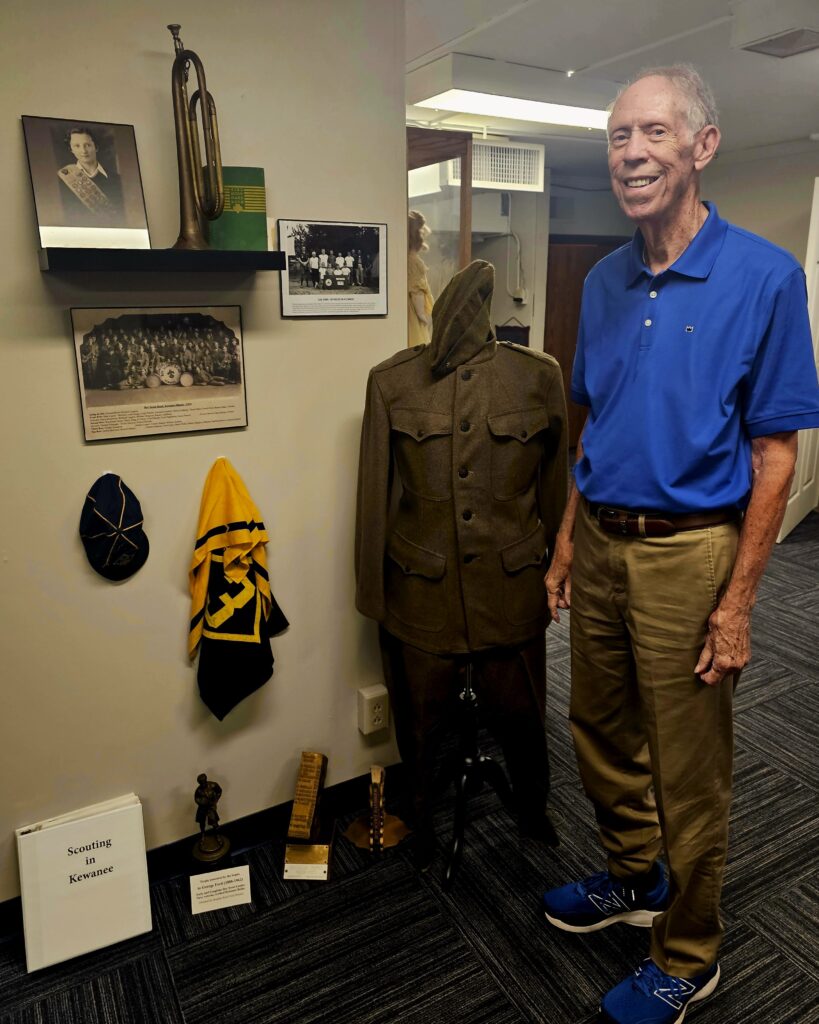
When Larry Lock and his wife, Pat, relocated as young teachers to Kewanee, Larry Lock isn’t afraid to admit that the couple wasn’t immediately taken with the town. But 55 years later, the community and its history has left an indelible mark upon Lock, and in return, he has left his mark on Kewanee.
Larry Lock wasn’t born in Kewanee, but in a hospital in Washington, Missouri, ten miles from his hometown of Union in 1941.
He attended the Immaculate Conception Grade School and went to St. Francis Borgia High School in Washington, a town with a population of 5,000 located 50 miles from St. Louis. He played sports in his younger days- baseball and basketball in HS and when he was just 13, he played in an All Star Game at Busch Stadium.
He attended Quincy University in Illinois and majored in physical education with a minor in history. In order to pay for college, Lock spent his summers and took off one entire semester after his second year to go to work as a shoe cutter, cutting out leather for women’s dress shoes by hand. The shoe factory was called Deb’s.
“I did that several summers including the semester I didn’t go to college.”
Influenced heavily by his high school coaches, Lock had ideas of molding the minds and talents of young athletes, but that’s not the path he would end up taking.
“I thought I was going to be a coach. The person that had the greatest influence on my life was my high school basketball coach and I wanted to be like him, but I came to realize that I didn’t have what it took to be a coach,” he said.
So upon graduating from Quincy in January of 1964, Lock secured a position as a student teacher at Quincy Jr. High.
It would be the next semester at Quincy Jr. High when Lock would meet his future wife. On the first day of school, Sept. 1, Lock and his housemate, who was also a teacher named Larry, walked through the halls of the school on a mission to get dates from two of the new teachers who had just begun the school year.
Lock immediately spotted Pat and his friend also saw someone who caught his eye. Not only did they both get dates that day, but they would both end up marrying those teachers.
After a brief engagement, Larry and Pat wed, and continued to teach at the junior high for several more years. But higher education called to him, and he returned to college.
“During that time, I worked on my master’s degree in history from Western,” he said.
In March of 1965, President Johnson sent combat forces into Vietnam, and Lock lost his teaching deferment. In the summer of 1966, he was drafted and immediately enlisted into Officer Candidate School. Lock made the trip to St. Louis for a physical and mental examination but, as fate would have it, he would never join the military.
During his sophomore year of college, a night of shenanigans ended with Lock falling from a second story window. He landed on his hand and broke his wrist. He remembered getting up and moving along to a few more taverns, but by 2 am, the pain was so great that he took himself off to the hospital.
That injury, which never healed properly, would make him, by military standards, unfit for service and provided him with an opportunity to continue teaching.
“The first thing I did was go out into the hall and call Pat to tell her I was 4F,” said Lock.
The next thing he did was call his draft board and alert them to his classification, officially ending his military career.
“Now that I’m 4F, I can teach another year,” he said.
In 1967, Lock had completed his master’s degree and was looking towards completing a PhD. He was accepted into the University of Missouri at Columbia, but after one year of classes, he could see that completing the degree would require another three years.
“So I decided I was going to give it up and get a job teaching high school.”
Lock sent resumes to seven or eight high schools, all of them in Illinois because at the time, he said, Illinois paid teachers better. Letters went out to places such as Quincy, Springfield, Galesburg, Peoria and of course, Kewanee.
“I had never heard of Kewanee, Illinois,” he said. “Never, not once, because at that time they had never made the state basketball tournament.”
On a map, Larry saw a town called Kewanee, and looked up the population. It was close to Galesburg so he sent off a resume and hoped for the best.
“By July 1, I didn’t have a job yet. Jim Golby, the superintendent, had lost his social studies, history teacher and head basketball coach at the high school,” Lock said.
It seemed like a sign when Supt. Golby reached out to him on or about July 1 and told him, “I think you have the job, but you’ll have to meet our fine principal, Marvin Damron.”
The two met at the Holiday Inn in Quincy and Damron was frank, telling Lock the job was his for the taking.
Lock accepted it on the spot and arrived in Kewanee in late August of 1968 in time for the start of the school year. Larry was just 27-years-old and Pat was 26.
“We arrived hauling a little U-Haul and as soon as we got here, we were to meet with Ken Sullens. Sullens was going to show us property to rent on Tremont and Chestnut.”

Unfortunately the properties were already occupied by other guests, mainly roaches, Lock said, so when Sullens took them to a trailer at Reecy’s Mobile Home Park, they were sold.
“It was nice, so we rented it.”
His first impression of Kewanee was underwhelming.
“We weren’t sure we liked it,” he admitted, but the couple was incredibly busy that first year and didn’t give it much more thought.
By the second semester, Lock added to his schedule, teaching US history for Black Hawk College, which utilized the campus at Kewanee High School.
Pat decided she didn’t want to go back to teaching and took on the job as librarian for Black Hawk at the high school at night.
“Towards the end of that year, I sent out applications to go elsewhere,” said Lock.
Kewanee wasn’t for them, they decided, and he put in applications for teaching positions in Aurora and Mattoon.
“I didn’t get either one,” he said.
Somewhat begrudgingly, the couple settled into Kewanee life, and over time, things began looking up.
“I had no regrets,” he said. “By the second year, we liked it.”
His second year of teaching included teaching US history for Black Hawk, and world history, world geography and US history at the high school. Pat took on a day job working for GTE.
Lock would teach for another 30 years, retiring from Kewanee High School in June of 2000 after 32 years of teaching there. After retirement, he had plans.
“I knew I was going to volunteer at the Kewanee Historical Society, play golf and leave for the winter,” said Lock. He even thought he would substitute teach but he never seemed to get around to it.
Instead, Lock immersed himself in Kewanee history, helped along by a request from his close friend, Steve Morrison. Morrison, also a retired KHS teacher, was compiling a periodical on the history of Henry County families from 1837 to 2000. He asked Lock to write a brief history of Kewanee to include in the book.
“The purpose of the book was for families to submit their historic photos and history. The idea was that if you did submit, you would buy a copy of the book,” he said.
Lock agreed to write the pages for Morrison and went to the best source for Kewanee history. He visited Bob Richards at the historical museum, which at the time was located at 211 N. Chestnut Street.
“I called him and made an appointment and he gave me a scrapbook of articles he had,” he said.
Lock spent three or four months researching and writing.
“I found it very interesting. Kewanee has a rich history.”
In his research, he found he was interested in all of Kewanee’s history, but there were historical citizens that he connected with.
“I almost feel a kinship to men like Sylvester Blish, Henry Little, Nelson Lay and his son Hiram Lay, ” he said.
He wrote 20 pages for the periodical and he has historical writings in several more. Dean Karau, a fellow Kewanee historian, assisted Lock in formatting his own book, “Kewanee 1854-2000,” which is still sold at the Kewanee museum and available for purchase on Amazon.
During his tenure, he got interested in powerpoint presentations and created several on topics such as Kewanee street cars and Woolworth and its predecessors. He’s presented them to various local groups and organizations.
From their volunteer work, Lock and his wife Pat have become an integral part of the Kewanee Historical Society and helped in the relocation and creation of the new museum, aptly named the Robert and Marcella Roberts Museum on Tremont Street. Yet none of it would have been possible, he said, without the vision and foresight of the historical society founder, Bob Richards.
Lock credits Richards in creating the Kewanee Historical Society and ensuring the preservation of Kewanee’s history for future generations. Richards, Lock said, got the idea that Kewanee should have a historical society at the time of the country’s bicentennial in 1976. The group’s first meeting was held at the Kewanee Public Library.
“Richards became the ‘moving force,’” Lock said.
When it was official, the historical society bought the Butterwick building and the rest, as they say, is history. Lock would rely on Richards for help in his research, as would other Kewanee historians like Dave Clarke of the Star Courier, and Lock would come to see Richards as a friend.
“I loved the guy,” Lock said. “I didn’t meet him until he was 90 years old.”
While Larry spends a great deal of time in a museum, he is the first to admit he’s not a “museum person.” He doesn’t particularly enjoy spending hours viewing artifacts or exhibits.
“My idea of a museum is to see something that I want to learn about and then I go read about it,” he said.
But there are items in the Robert and Marcella Richards Museum that interest him. He particularly enjoys looking through the city directories and can tell anyone who asks that Kewanee in 1876, had roughly 4,000 residents. He also loves poring over the salary ledgers from Woolworth, particularly the late 1920’s from 1926 to 1929 and guesses workers at that time made an average of 30 to 40 cents an hour.
“But a glass of beer and a loaf of bread was a nickel,” he said.
As a teacher, Lock had his favorite subjects, especially government, which he took over from Lucille Brockman. The Revolutionary War, the Civil War, both pre and post, the New Deal and the history of Latin America also counted high on his list of favorite topics to teach.
Today, Lock is still interested in government, current affairs and politics and on the topic of the current day turmoil that his country finds itself in, Lock seems confident that democracy will endure.
“Well, what’s going on is unfortunate, but it’s nothing new. We’ve been through this before. We’ll get through it. I remain optimistic,” said Lock.
The Locks will move away from a town they have called home before month’s end and just as they never planned to stay, they also never planned to leave. But Lock said moving to Colorado to be closer to their only daughter, Amy, is the right decision for the couple.
There is much they will miss about their adopted hometown, and the feeling will no doubt be reciprocated.
“We’ll miss our friends. We’ll miss the museum. It’s a labor of love. I will miss it. My wife, as much as I will. We’ve definitely done it together.”
As far as future plans, Lock said he may write another book, but writing articles for The Kewanee Voice could be a very real possibility. But whatever he does, Kewanee probably hasn’t heard the last from him.
The couple have come a long way from the young teachers who thought long and hard about staying. They now find it difficult to leave behind.
“We really came to like Kewanee. It’s home. Boilermaker forever.” Lock said.