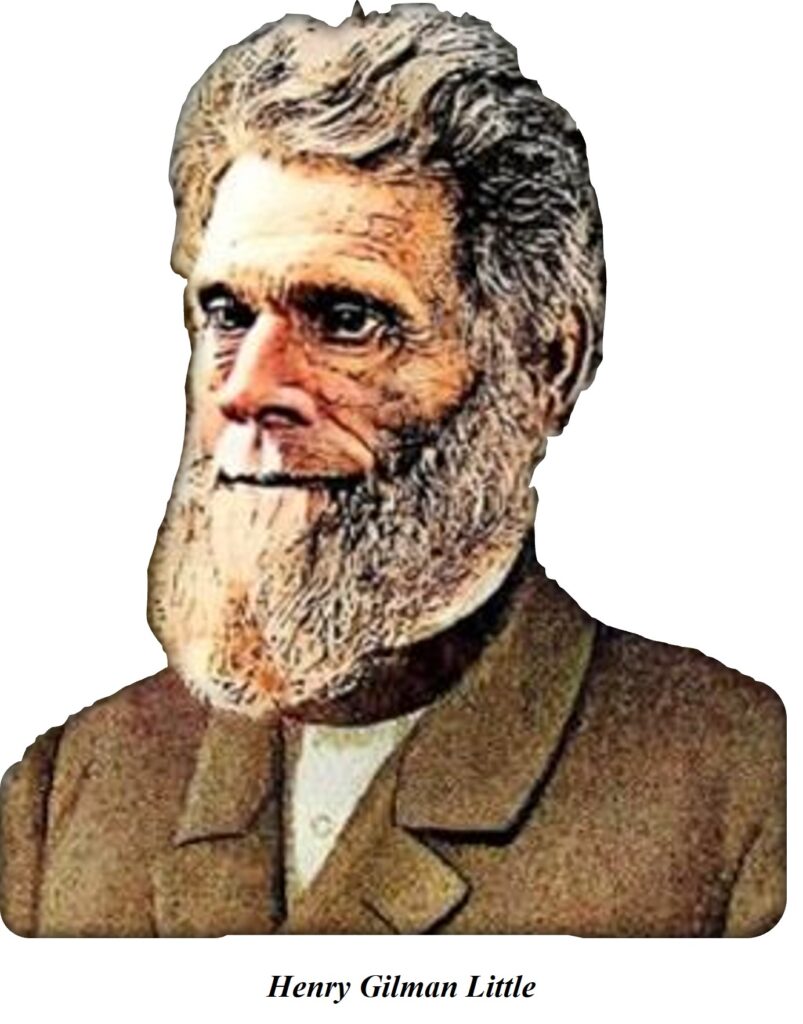
Henry Gilman Little was one of the original Wethersfield colonists in 1836. He soon became an influential figure in the colony, in Henry County, and later in the state.
In 1854, Little became one of the founding fathers of Kewanee. In the late 1850s, he became friends with Abraham Lincoln when Little served a term in the Illinois legislature.
In 1860, Little moved to Oberlin, Ohio, to see to the college education of his children. Then, in 1868, he and his family moved to Grinnell, Iowa, where Little became a leading citizen and served multiple terms as mayor. Henry G. Little died in Grinnell in 1900.
But a little-known adventure of Little’s occurred in late 1841 when he ventured out west to the Iowa Territory. This is the story of that adventure.
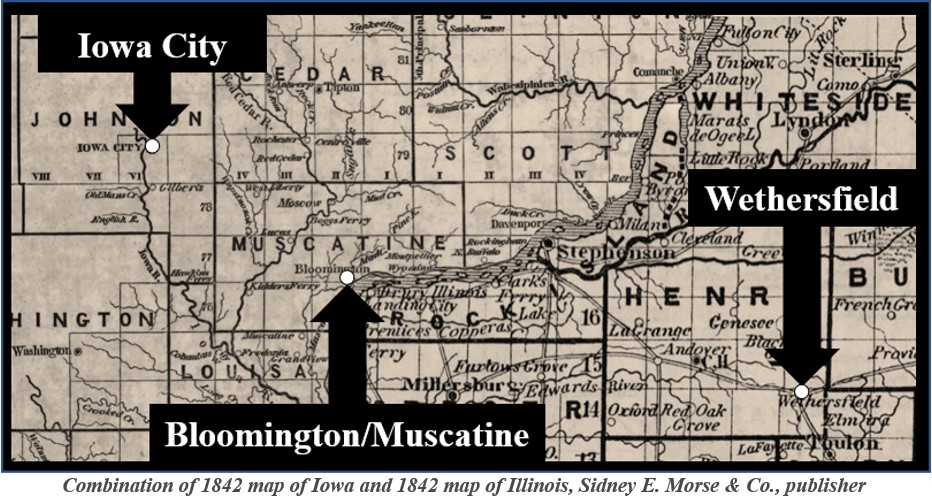
Not long after Wethersfield was founded, Little observed a constant stream of emigrants westward, all bound for the “Black Hawk Purchase” in the Iowa territory, 30 million acres of land in Eastern Iowa ceded to the United States at the end of The Blackhawk War in 1832.
The travelers were aiming for “The Yellow Banks” as the most convenient point for crossing the Mississippi. A town soon sprang up at the river crossing, originally named Bloomington, but later changed to Muscatine.

In 1839, Iowa City was named the capital of the territory, and the town was struck with “a boom.” It grew much faster than the surrounding country was developed, so that supplies for the population had to be brought in from towns along the river and even farther away.
In 1841, Wethersfielders learned that Iowa City was very short of flour. Little had a quantity of surplus wheat which he had ground into flour at the Wethersfield mill, and he decided to take a wagon-load to Iowa City.
Little’s almost hundred-mile journey was, he said, “long and tedious and somewhat adventurous.” He traveled in a heavily-loaded wagon “over the wretched roads of those days in the West.” But he said that “it was quite to my taste then, when I was young and my strength ‘was as the strength of ten.’” Although few of the streams were bridged and thus had to be forded, he was not overwhelmed by the conditions.
Little traveled with his favorite dog, named “Hero.” Hero, half-greyhound, provided entertainment for the monotony of the long days by making things lively for the wild game along the road. Being “keen of eye and swift of foot . . . [m]any a wild chase he gave the fleet-footed deer; but all were unsuccessful for his was not a match for that of those graceful, untamed creatures.”
Little crossed the river at Bloomington and eventually reached the Iowa capital. He soon was able to sell off his flour at a good profit. Little found several old acquaintances and was intrigued by the new town and decided to spend several days there. But Little found that “the great excitement of the hour was caused by the depredations of wolves about the neighborhood.”
Two populations of gray wolves originally occurred in Iowa prior to European settlement. The Great Plains wolf followed the bison herds on the prairies in the west while the eastern timber wolf was found primarily in the eastern third of the state. Both prairie and timber wolves could be found around Iowa City.
Little learned that public meetings were being held, and “the people were stirred to energetic action by the harrowing tales told by settlers from near and far of destructive raids by the prowling ‘varmints.’” Smaller livestock had been carried off, and the farmers feared shortages for the approaching winter.
Therefore, the citizenry scheduled a “grand” wolf hunt by all the able-bodied men and boys. They chose leaders and adopted plans “for turning the tables upon the gray terrors . . . .”
They first built a stand on a high point of land a few miles east of town along the Muscatine Road, where they stationed the best sharpshooters.
Then, the rest of the citizens of the town and surrounding countryside were spread in a five-mile circle around the stand. Those participants were either on horseback or foot, but all were to close in toward the stand at a steady pace. They were to keep a “watch that no guilty animal should escape, and driving before them, inexorable as fate, the scores or hundreds of the gray rascals with which imagination had peopled the prairie, to the fearful slaughter which awaited them at the grand round-up.”
No one but the sharpshooters were armed with guns in order to avoid accidents, but they carried “ferocious looking clubs.”
Little planned the start of his trip home so that he could observe the hunt and its apex at the stand “in time to witness the grand massacre.” He saw men on horseback spaced at intervals with the boys in between as they all converged on the stand. He and his wagon were only a short distance outside the ring with his dog trotting beside him, when “suddenly Hero gave a start and shot off like lightning through the grass. I saw that he had caught sight of a wolf which had slipped between the hunters partly hidden by the grass. Lashing my horses to the top of their speed I followed, Hero overtook the wolf, at one snap seized him in his teeth and whirled him over his back. Then at the sight of the savage teeth and wicked eyes he seemed frightened to hold on, and dropped the wolf who was off again like a shot. Again and again Hero seized and threw him only to drop him as before. One of the horsemen now came to the dog’s help and despatched [sic] the beast with his club. It was a large vicious-looking prairie wolf. The man threw the carcass into my wagon and we went up to the stand. The wolf hunters crowded around to gaze upon the enemy as he was held up by his long gray tail.”
It turned out that Hero’s wolf was the only one seen that day. Little said that “my Illinois dog, Hero, was, after all, the hero of the day.” Little received a number of offers for his dog from the hunters, but he and Hero made their way back to Wethersfield together.
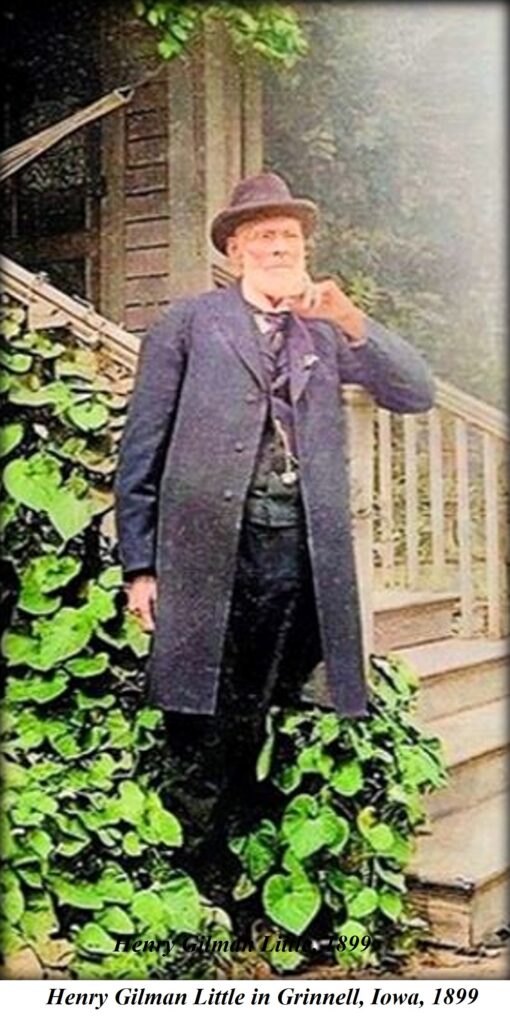
Almost thirty years later, Little returned to Iowa permanently, where he lived for the rest of his life. But that day in the early 1840s for the Wethersfield and later Kewanee founding father remained
“fresh and vivid to my memory . . . the Iowa City hunt on my first visit to the state which was many years later to become my home.”