The First Presbyterian Church will celebrate Juneteenth, and the church’s board and congregation are inviting the community to join them at 307 S. Tremont on Saturday, June 15 from 1 to 4 p.m. to embrace and commemorate the national holiday.
In order to widen and deepen the celebration of the day, the church offered a brief history and reflection.
Though the Emancipation Proclamation was issued January 1, 1863, it was not until more than two years later that the people of Texas, the most remote state of the former Confederacy, first learned of freedom for enslaved people.
Union soldiers following the end of the Civil War traveled to Galveston where the pronouncement was publicly read on June 19, 1865.
Celebrations of Juneteenth started in Texas, which declared Juneteenth a state holiday in 1980. By 2019, forty-seven states recognized Juneteenth, and it became a federal holiday in 2021.
In the immediate post-Civil War era, there was much hope that the formerly enslaved people would finally have peaceful and free lives. Families tried to reunite. The granting of land by the federal government promised to provide a means to live, and African American men were given the right to vote.
During Reconstruction, 16 African Americans were elected to the U.S. Congress, 600 to state legislatures, and hundreds more to local offices. However, the backlash against these changes was swift, widespread, and ruthless. The land grants were taken back within a year. African Americans were depicted as little more than savages while Ku Klux Klansmen were depicted as saviors, as famously portrayed in the 1915 film The Birth of a Nation. Lynchings, Black Codes, and Jim Crow laws that only applied or were only enforced against Black people kept the formerly enslaved people subservient. One example was the practice of imprisoning formerly enslaved people for violations of vagrancy laws and using the resulting prison labor for profit.
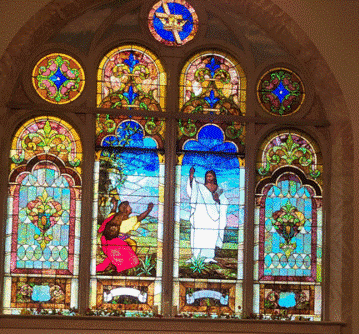
While this is a time for reflection, there will be a rededication of the rare First Presbyterian stained glass windows depicting Jesus as a person of color, within the sanctuary, by Rev. Eric Heinekamp, transformational general presbyter and stated clerk, along with Rev. Art Blegen.
Related story: It took fresh eyes to point out just how significant those windows are to members of a rural congregation | Kewanee Voice
“Community churches and leaders will be in attendance and participating. . . anti-racism goes beyond diversity. It is a spiritual practice of self-reflection that examines how we individually live out the truth that God created humanity in God’s own image. It examines the structures that comprise our processes and practices to understand their impact on people and works to identify and remove structural obstacles to full participation by all in the life of the church,” a news statement issued by the church reads.