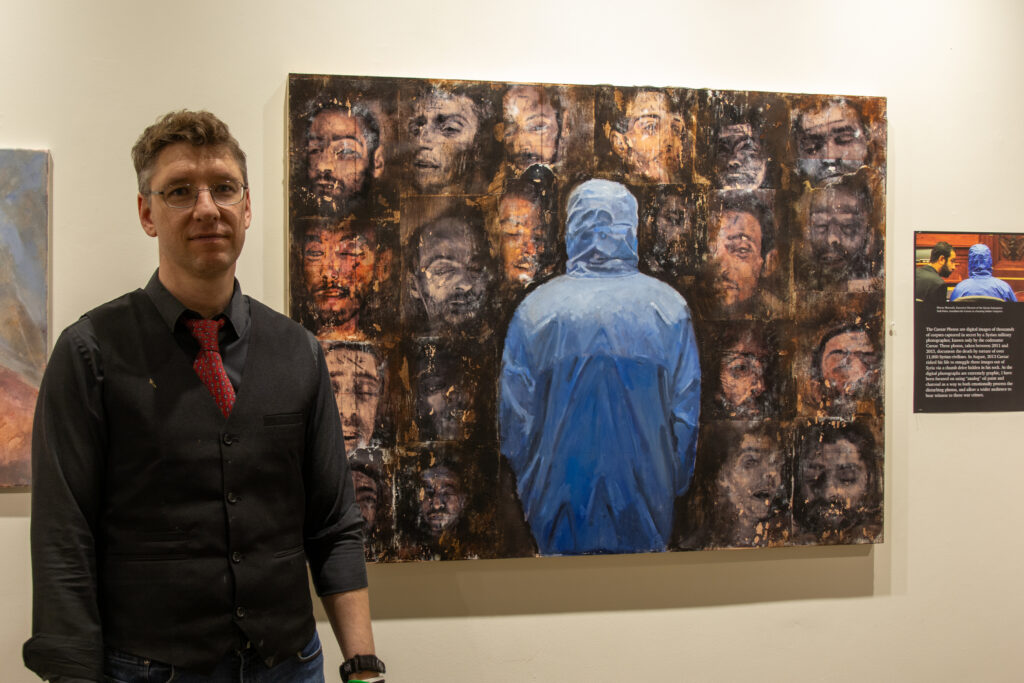
The work of a Kewanee artist and teacher is being featured in an exhibit titled, “The Caesar Files: War Crimes in the Digital Age” at Western Illinois University.
Marc Nelson, who teaches art at Central School, has made the news before not only with his unique art projects designed to teach empathy and awareness, but also for his remote art classes with Syrian students and the contribution of his artwork featured in an award-winning 2021 documentary “Bringing Assad to Justice.”
With his new exhibit, Nelson again trains his gifts on the plight of Syrians with a focus on responding to contemporary images, shared on social media of civilians affected by the conflict in Syria.
“I am drawn to photography’s ability to both suspend time and suggest movement, and I seek a way to use art to create works that are both static and fluid,” said Nelson.
Unlike when the Holocaust’s horrors were revealed to the wider world only after the camps were liberated, photos and videos of the civilians being murdered by their government in Syria are being shared in real-time, for everyone to see, he said.
Nelson said there is an “inherent ephemerality to media shared on Twitter and Instagram.”
“I attempt to reflect on these quickly scrolled by images through the time-consuming act of drawing and painting,” said Nelson.
Often his work has attempted to abstract the photographic source image just enough to bypass social media’s graphic content filters so they can be shared freely on the internet as well as in publications, exhibitions and documentaries. Ronan Tynan, producer and director of the documentary “Bringing Assad to Justice” applauded Nelson’s art, stating that his “drawings convey the horror and the crimes but in not forcing the viewer to turn away, he also leaves room for outrage.”
Many of the painting and monotypes in his new exhibit depict the “Caesar Photos,” or digital images of thousands of corpses captured in secret by a Syrian military photographer, known only by his codename, Caesar. These grim photos, taken between 2011 and 2013, document the death by torture of over 11,000 Syrian civilians.
“In August, 2013, Caesar risked his life to smuggle these images out of Syria via a thumb drive hidden in his sock,” said Nelson.
Due to their graphic nature, Nelson has chosen to utilize “analog” charcoal and pigment as a way to both emotionally process the disturbing photos and ensure a wider audience “to bear witness to these war crimes.”
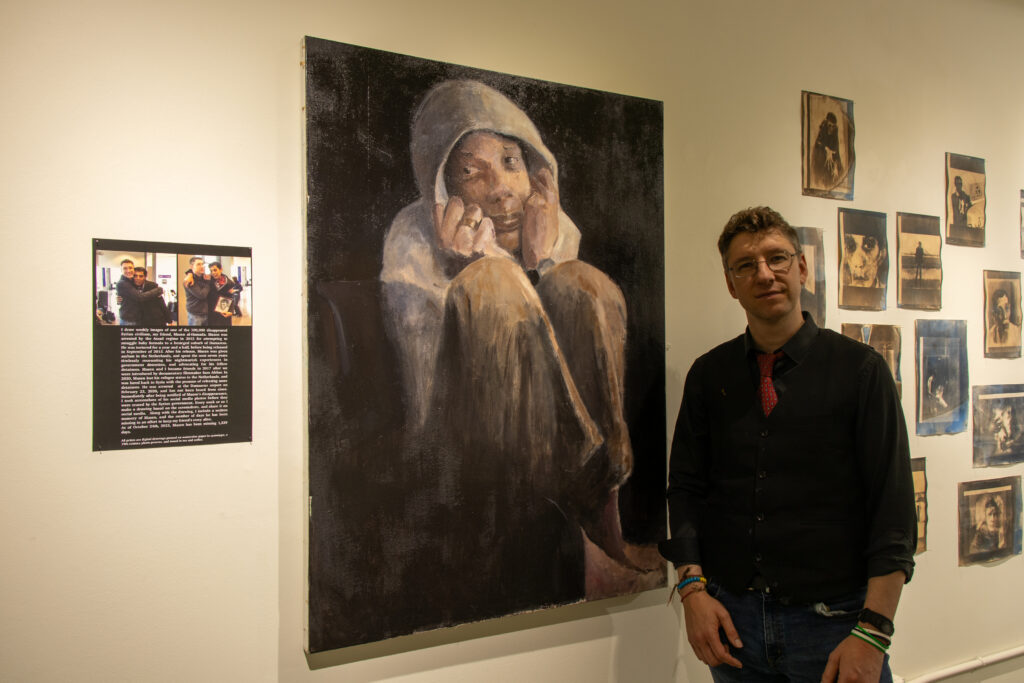
Alongside the Caesar paintings and prints, are his weekly drawing of images of just one of the 100,000 disappeared Syrian civilians, his friend, Mazen al-Hamada. Mazen was arrested by the Assad regime in 2012 for attempting to smuggle baby formula to a besieged suburb of Damascus.
Nelson became friends with Mazen when the pair met in 2017, four years after Mazen was released from prison, but only after being tortured for a year and a half. Mazen sought asylum in the Netherlands and Nelson was introduced to him by documentary filmmaker Sara Afshar.
In 2020, on a promise of releasing detainees, his friend was lured back to Syria and arrested at the Damascus airport. No one has seen or heard from his since, and over the years, Nelson has used his art to keep his friend’s memory alive.
“I took screenshots of his social media photos before they were erased by the Syrian government. Every week or so I make a drawing based on the screenshots, and share it on social media. Along with the drawing, I include a written memory of Mazen, and the number of days he has been missing in an effort to keep my friend’s story alive,” said Nelson.
In all, there are nine paintings and 27 prints on watercolor paper that are part of Nelson’s exhibit.
“For the painting, I use charcoal, acrylic and oil paint-sometimes ground by hand. I usually use wood panels or canvas for the painting’s substrate.”
The source material for his prints of his missing friend, Mazen, are digital images he made on his iPad. The images are then “developed” on watercolor paper using the 19th century cyanotype process. The cyanotypes are then soaked in tea, coffee, or a homemade iron gall ink.
All of his painting have been created in the last three months in preparation of the exhibit, excluding the prints of Mazen that have been made over the last years- and counting.
Nelson admits that many of his works are “challenging to look at” but he hopes that people who view them will “both learn about the lives stolen by the Assad regime in Syrian, and the Putin regime in Russia.
“And also,” he said, “be moved to raise their own voice, or create their own art, poetry, music in support of civilians suffering under tyranny and oppression around the world.”
Nelson said there are straightforward ways that people can make an immediate impact and that would be to make a charitable donation to organizations working on-the-ground with displaced person in both Syria and Ukraine. Two such groups, Nelson said, are MedGlobal and the Syrian Emergency Task Force, based in Washington D.C.
It’s Nelson’s hope for future displays of his work at other galleries and universities. Currently, he is illustrating the experiences of a photojournalist in the Ukraine and in the next month his eighth graders will be preparing Central School’s next stop-motion movie set in Ukraine during two time periods, WWII and present day.
All artist need a muse, and Nelson, most assuredly has one.
“I want to thank my wife, Jill Bartelt, for supporting, encouraging, and inspiring me to champion the voiceless of this earth with kindness and compassion,” said Nelson.
Nelson’s exhibit, “The Caesar Files: War Crimes in a Digital Age” will be on display at the Annex Gallery-WIU from Oct. 24 through Nov. 17. A reception, officially opening the show, was held on Oct. 24.