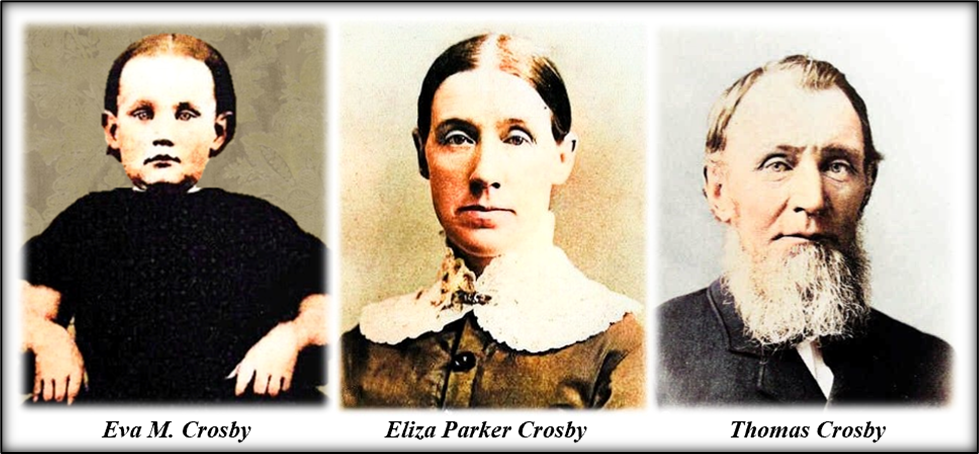
“There wasn’t a breath of wind. nor was there a cloud in the sky. It was a perfect summer day. The moon had obscured only a very small portion of the sun, when we noticed the peculiar shape that the sun was taking on. . . . [W]e realized that something out of the ordinary was happening. and we ran to the house to tell mother. Of course, she knew instantly what was taking place. She lit a lamp and smoked a piece of glass for each member of the family, so that, without hurting our eyes, we could look as long as we wished upon one of the greatest astronomical occurrences. Before she had finished, father came in from the field.”
That was part of nine-year-old Eva M. Crosby’s recollection of the total eclipse of the sun she and her family experienced from their farm in Annawan Township northeast of Kewanee on August 7, 1869.
Early in human history, people believed eclipses to be supernatural events, causing or influencing tragic happenings. Yet as early as 500 B.C., some were looking to natural causes rather than supernatural ones. When Aristotle saw the shadow of the Earth cast on the moon during a lunar eclipse, he noticed that the shadow was always circular and said that the Earth must be a sphere. Edmund Halley, of Halley’s Comet fame, argued that people shouldn’t be afraid of an eclipse which “proceeds only from natural Causes; and is nothing else but the direct [i]interposition of the Body of the Moon between our Sight and the Sun.”
By the time of the 1869 eclipse during which Kewanee was on the northern edge of the path of totality, almost everyone recognized that they were natural occurrences. That still made them special and unique.
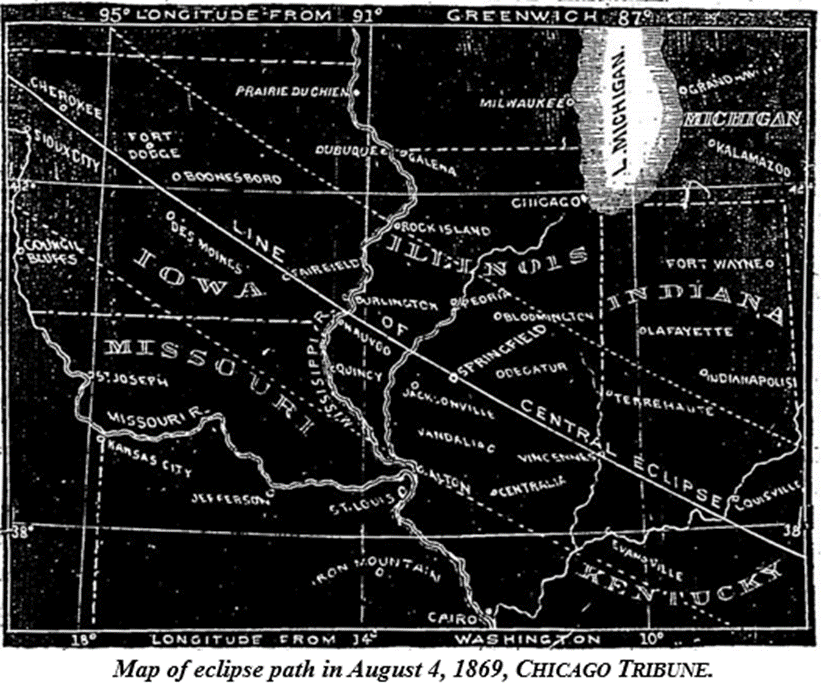
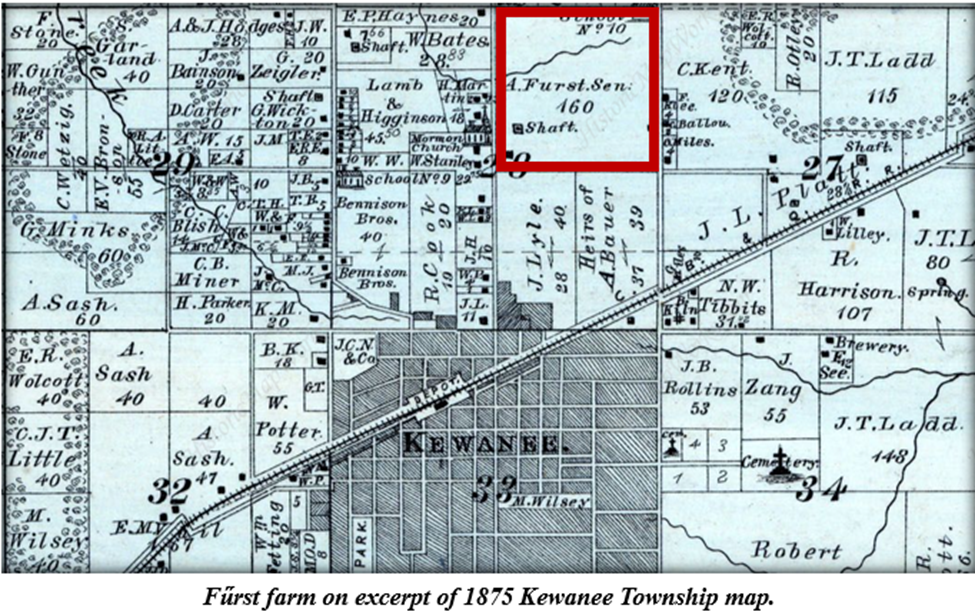
E. P. Austin and A. L. Covert of the American Nautical Almanac arrived in Kewanee on the afternoon of Friday, August 6, 1869, to observe the eclipse. Austin reported that the weather was cloudy with occasional heavy rain which continued until evening. After disembarking from the Chicago, Burlington & Quincy train at the depot, they traveled north to the farm of August Fűrst, Sr., where they had arranged to observe the eclipse.
The weather remained cloudy until around 9:30 p.m. Friday night, when the clouds broke. By Saturday morning, there were only faint traces of clouds, the sky seemingly purified by the heavy rains, creating perfect conditions in which to observe the eclipse.
They set up and adjusted a large telescope, and then the eclipse began late afternoon – the exact time was not initially noted by the men because of the subtlety of its beginning.
“The blue was changing to a dusky color, which might have been described as a blue-gray with a red tinge. The birds flew round perplexed. and then settled for the apparent night. The barnyard fowls were equally puzzled and finally ran all their might to the chicken house! This had a beneficial effect on us; for it relieved the tension. and we all laughed, forgetting for the moment how serious we had become. . . . We didn’t talk. We just stood there looking. looking. This was a ‘moving picture’ of incomparable magnificence.”
Austin wrote that first the large spot on the sun’s limb disappeared, followed by a slight elongation of the cusps of the sun. Then three small spots near the center of the sun disappeared. The limb of the sun then began to have a tremulous motion and there was an appearance of light streaming from the extremity of the cusps. A Kewaneean standing nearby called out, “here it comes,” and a few seconds later, “here it is.” After adjusting the telescope, Austin saw red flames moving along the limb of the moon. Then looking at the sky without the telescope, he saw the whole outline of the moon surrounded by a brilliant halo.
“At last the sun was covered, and there flashed out over the darkness a soft silvery light which bordered the black rim of the moon’s shadow with splendor – the corona. . . .”
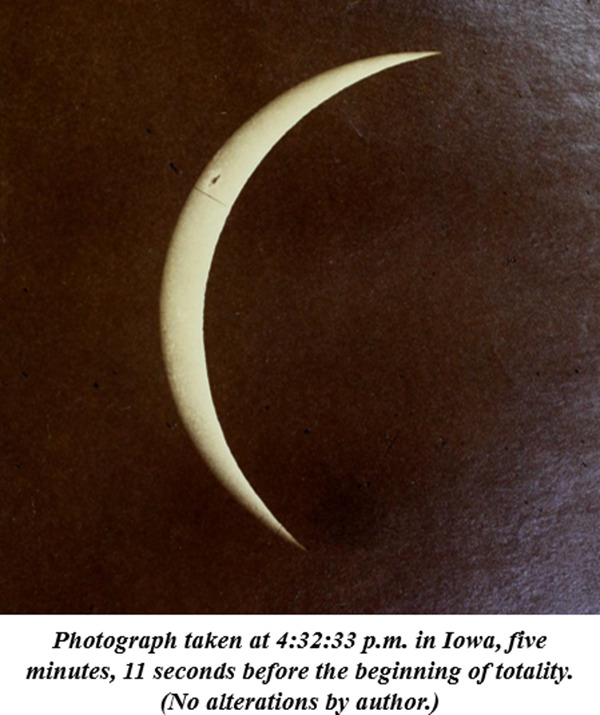
Austin noted that chickens went to roost several minutes before totality, and turkeys came in from the field. Mr. Furst believed that the duration of totality lasted about 70 seconds to the naked eye, and Venus and Mercury were seen by bystanders during the totality.
“The total phase lasted only about five minutes; for the moon never paused but continued to move majestically along in its course, and very soon that part of the sun that had been covered first revealed itself.”
Austin observed that the day had been very hot with considerable wind but which died out by the time the sun was half eclipsed. Everything had a somber appearance and the heat of the sun was no longer oppressive. Near totality, Austin wrote, there was a slight chilly feeling. After the eclipse, it warmed again, although the sun was near the horizon.
“The awesome feeling that had held us began to relax its grip. Now we felt that everything was going to be all right again. ln the course of about twenty minutes, the twitter of birds began to be heard, and directly the roosters began to crow thinking, no doubt, a new day was dawning; and the chickens began to come out into the barnyard again.”
Soon, Austin and Covert returned to the train depot to send telegrams about the eclipse to the scientific community.
“A feeling of cheer pervaded the atmosphere and everybody, and apparently everything, was happy again. But we continued to watch until the moon with its curved edge moved entirely off, revealing gradually more and more of the glorious orb it had so effectively obscured.”
“This total eclipse of the sun was witnessed under perfect conditions – a treasured memory.”
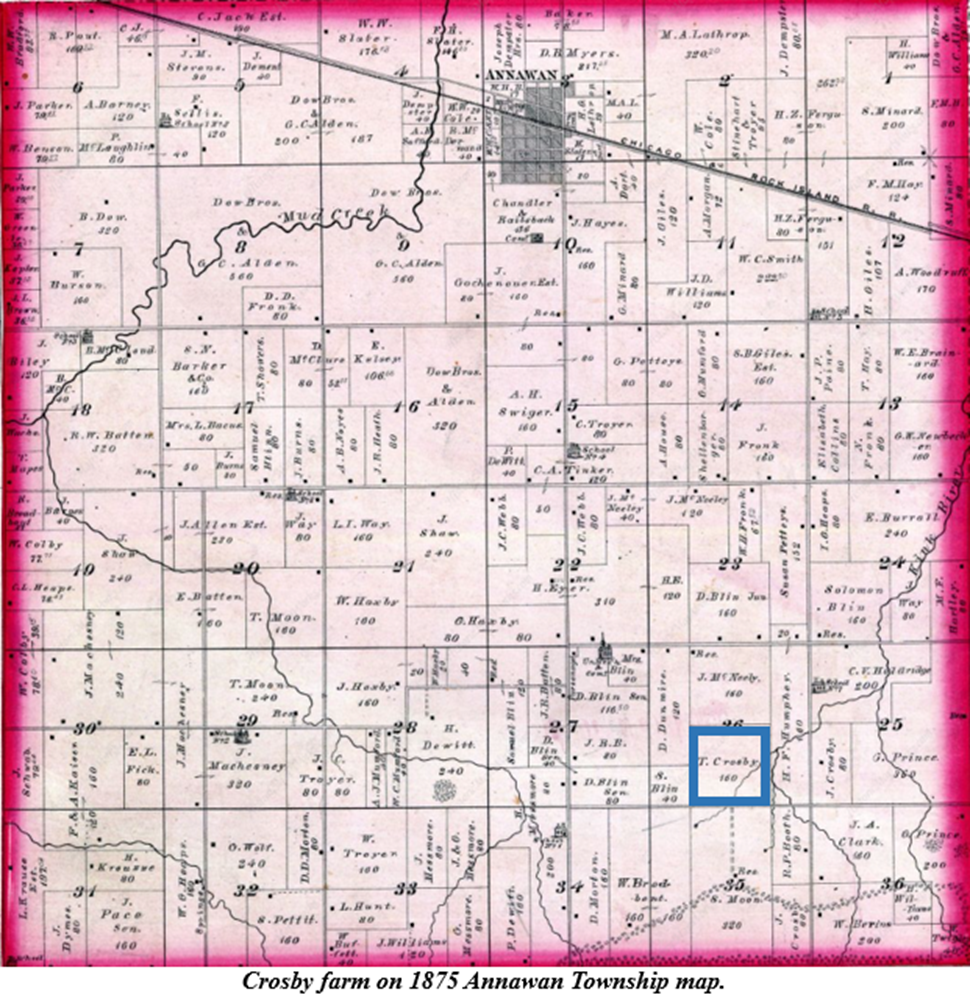
(You can find Eva M. Crosby Kellogg’s recollection and more stories of Henry County in her book, Crosbys Of Henry County, Illinois 1851-1936.)